Confucius Institute - Budapest, Hungary


Elte Confucius Institute Held a Lecture on “the Symbolic Meaning of Animals in Traditional Chinese Flower and Bird Paintings
2022. March 29.
On March 29th (local time), the Confucius Institute at ELTE University hosted a lecture on “The symbolic meaning of animals in traditional Chinese bird and flower paintings.” Mr. Horváth Janisz, a renowned Hungarian painter and calligrapher, delivered the lecture. It lasted 90 minutes, and 13 Hungarians who were interested in traditional Chinese bird and flower painting attended.
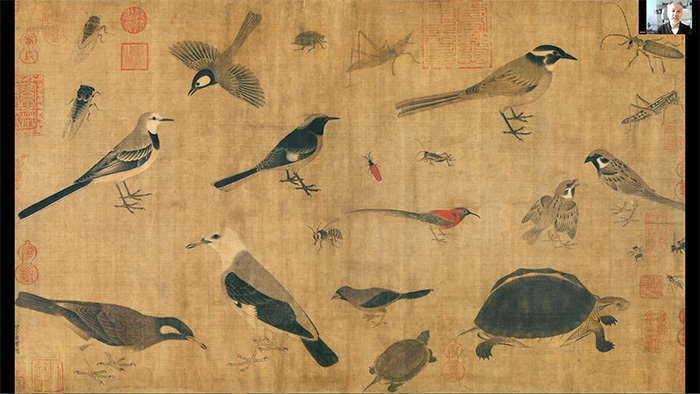
A Selection of Paintings
Both the use of color and the painting techniques involved in traditional Chinese painting were covered in the lecture. At the lecture, Mr. Horváth explained to the audience that certain animals signify and convey positive symbolic meanings, which is why they are more frequently depicted in paintings.
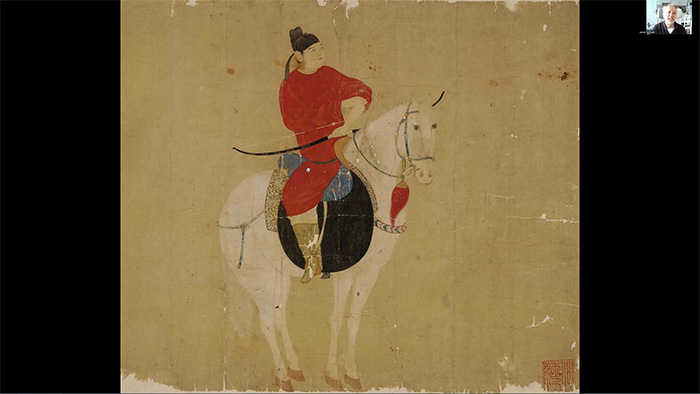
Paintings Related to the Change of Techniques and skills
Mr. Horváth also illustrated the evolution and change of painting techniques and skills throughout the centuries, guiding the audience through the application of painting techniques and the representation of their color characteristics in paintings from the Song, Yuan, and Ming dynasties.
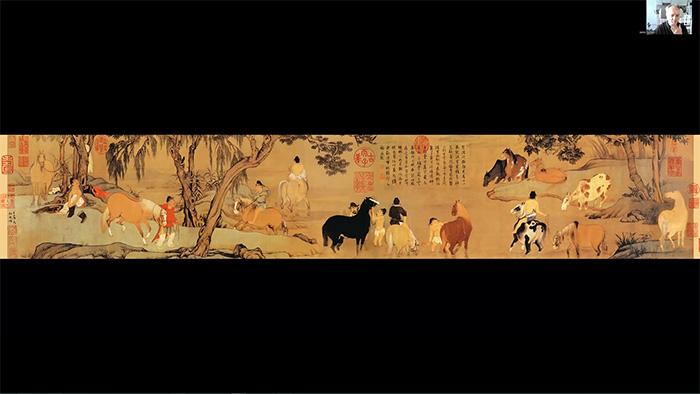
Seals in Paintings
Additionally, as a supplement to his January lecture on “The Aesthetics of Chinese Seal Culture,” he developed a detailed explanation of the seal’s role in painting during this lecture, which provided an opportunity to learn more about the Chinese seal culture’s distinctive charm.
Mr. Horváth concluded the lecture by emphasizing one trait of traditional Chinese bird and flower paintings: while they are nature-oriented, they do not truly reflect the actual scenery. For example, the height of the trees and the size of the leaves of the plants in the painting are not necessarily realistic representations.
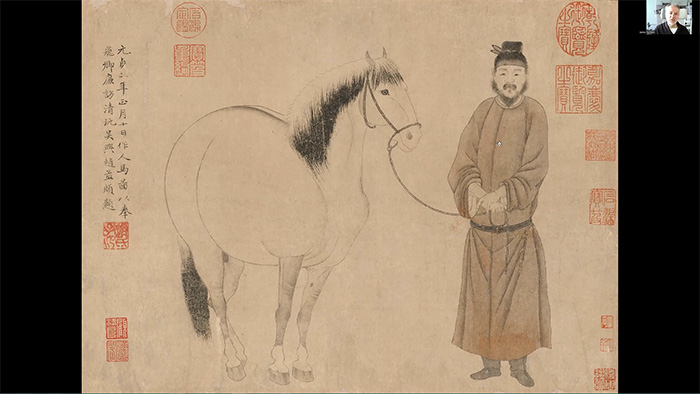
A Selection of Zhao Mengfu’s Famous Paintings
It’s worth noting that Mr. Horváth also shared stories about Zhao Mengfu, the famous calligrapher and painter of the Yuan Dynasty, by demonstrating and analyzing his works and skills. The audience responded positively to the lecture; following the lecture, the audience actively posed questions and engaged in a lively conversation with the presenter about the lecture’s substance and associated issues.
Author: Liu Xiaoqi
Picture: Gájász Enikő
Reviewer: Li Denggui
Article Provided by ELTE Confucius Institute
PREVIOUS NEWS
-
Taiji Classes Continue at ELTE in the Spring Semester
2026-06-29 -
Children’s Day on Shipyard Island
2026-05-31 -
In the Footsteps of the First Chinese Emperor – A Lecture in Connection with the Exhibition at the Museum of Fine Arts
2026-05-28 -
The ELTE Confucius Institute Celebrated Its 20th Anniversary
2026-04-29 -
Chinese Culture and Traditions at the Museum+ Programme
2026-03-11 -
Colourful Lunar New Year Celebrations at GOBUDA Mall
2026-02-21 -
New Confucius Institute Opens at Széchenyi István University in Győr
2026-01-23 -
Chinese New Year Celebrations at ELTE Radnóti Miklós Primary and Secondary School
2026-01-23 -
Guided Tour of the Exhibition Timeless Modernity – Hungarian Architectural Heritage in Shanghai
2026-01-15 -
The Legacy of the Early Emperors: Inscriptions from the Qin Period
2025-12-05 -
Advanced Landscape Painting Course in the Autumn Semester
2025-11-28 -
ELTE Confucius Institute at the Museum of Fine Arts
2025-11-27 -
The Confucius Institute at ELTE has once again been awarded the title of "Excellent HSK Test Center" this year.
2025-11-15 -
Asia Days at GOBUDA Mall
2025-11-15 -
Chinese Calligraphy Course Launched at the ELTE Confucius Institute
2025-10-23 -
Prof. Dr. Imre Hamar Delivers His Inaugural Academic Lecture
2025-10-13 -
Confucius Day at ELTE – A Celebration of Chinese Culture for All Ages
2025-10-11 -
Professor Dr. Imre Hamar Honored Among ELTE Award Recipients
2025-09-05 -
Dialogue for Strengthening Chinese–Hungarian Educational and Intercultural Relations
2025-06-26 -
"Magical East" at the Tokaj Museum
2025-06-21 -
More Successes for ELTE Confucius Institute Students (18th Chinese Bridge)
2025-06-06 -
Successful Participation in the Dubbing Contest of Beijing Foreign Studies University
2025-06-04 -
The 12th Training Program of the ELTE Central and Eastern European Regional Teacher Training Center Successfully Concluded
May 8–12, 2025
2025-05-09 -
Professor Dr. Imre Hamar Elected as a Member of the Hungarian Academy of Sciences
2025-05-07 -
The ELTE Confucius Institute visited Dabasi Táncsics Mihály High School
2025-04-08 -
Professor Li Chen, lecturer at the Luxun Academy of Fine Arts, visited the ELTE Con-fucius Institute
2025-04-07 -
Chinese New Year Festival in Budapest's Chinatown
2024-01-28 -
Online Lecture by István Olajos on the Development of Chinese Manhua
2024-01-26 -
Konfucius's Kitchen: Experiences from the Magic of Chinese Cuisine!
2024-01-09 -
For the first time in the region, we organised the first and this year the only Chinese medical language exam in the world!
2023-11-25 -
ELTE Achieves Award for Outstanding Performance in CNKI Academic Power-Up Program
2023-11-25 -
Hundred Years of the ELTE Chinese Department
2023-11-20 -
Eleventh training course of the ELTE Central and Eastern European Regional Teacher Training Centre was successfully completed
2023-11-16 -
ELTE Confucius Institute successfully held the last YCT language exam this year
2023-11-11 -
Three suitable courses for complete beginners in calligraphy!
2023-10-20 -
The first HSK and HSKK exams for the autumn semester of the 2023/2024 academic year have been held
2023-10-15 -
Mid-Autumn Festival at the Confucius Institute of ELTE
2023-10-13 -
ELTE Confucius Institute was present at the Open Day of the University again this year
2023-10-13 -
Chinese painting courses at the ELTE Confucius Institute continue to be very popular
2023-10-10 -
Chinese cultural programme at the Marriott Hotel
2023-10-06 -
A full house at this year's Confucius Day
2023-09-30 -
The Kodály Hall was full on the Night of Researchers
2023-09-29 -
The ELTE Confucius Institute started teaching taiji to undergraduates
2023-09-12 -
The last HSK and HSKK exams of the spring semester 2022/2023 have been completed
2023-07-16 -
The ELTE Chinese Department turns 100 years old!
2023-06-07 -
Sándor Kőrösi Csoma commemorated by Political Director Dr Balázs Orbán
2023-06-05 -
The Children’s Day was a huge success at the City Park
2023-05-28 -
Beijing Foreign Language University Delegation Strengthens Academic Ties during Momentous Visit to Hungary
2023-05-25 -
China expert Dr. Gergely Salát gave a lecture titled "Road and Belt.
2023-05-25 -
Renowned Director Xie Fei Inspires and Connects at Our Institute
2023-05-24 -
ELTE Confucius Institute Makes History with Inaugural China Career Day
2023-05-24 -
A Success Story at the ELTE Chinese Career Day
2023-05-24 -
Our traditional 8-day calligraphy course is underway
2023-04-21 -
The ELTE Confucius Institute participated again this year in the Earth Day at the Budapest Zoo
2023-04-21 -
The ELTE Confucius Institute Chinese Painting Courses continue to be very popular
2023-04-20 -
ELTE Confucius Institute Holds Second All-Teachers Meeting for 2022-2023 Academic Year
2023-03-31 -
The "Chinese Day" was a great success at the Jezsuita high school in Miskolc
2023-03-21 -
The ELTE Confucius Institute held its first HSK Chinese Proficiency Test of the year
2023-03-18 -
Chinese and Japanese design (Lecture by Janisz Horvath)
2023-03-17 -
A delegation from iFLYTEK visits ELTE
2023-02-28 -
Professor Dr. Imre Hamar was invited to speak at the All China Chinese Language Teachers Association 2023 Annual Conference
2023-02-25 -
The ELTE Roman World and the Far East Research Group has been founded
2022-12-20 -
ELTE Confucius Institute Opens a New Cycle of Courses in Advanced Chinese Painting
2022-12-19 -
The Confucius Institute at ELTE University Held a Lecture on "The Difference Between Chinese and Japanese Painting"
2022-12-16 -
The Confucius Institute at ELTE University Held its Last Chinese Language Exam of the Year
2022-12-04 -
Confucius Institute at ELTE University Hosted a Performance by Exchange Students from the Zhejiang Conservatory of Music
2022-12-02 -
Confucius Institute at ELTE University Hosted a Lecture on "Modern Chinese Business“
2022-11-29 -
Painting and aesthetics of the Tang Dynasty and the Five Dynasty
period
2022-11-25 -
Chinese Art Competition
2022-11-24 -
Chen Kun, Education Counsellor of the Chinese Embassy in Hungary, Visits Eötvös Loránd University
2022-11-18 -
The 10th Central and Eastern European Chinese teacher training course of ELTE finished with great success.
2022-11-18 -
Lecture by Levente Horváth: Chinese Geopolitical Thinking
2022-10-24 -
This year the ELTE Confucius Institute participated in the university’s open day
2022-10-14 -
The Colors of Chinese Landscape Paintings
2022-10-07 -
Researchers' Night
2022-09-30 -
Ink and Brush Book Launch and Exhibition
2022-09-29 -
Confucius Day
2022-09-24 -
ELTE Confucius Institute Celebrates Its 15th Anniversary
2022-06-21 -
The Central- and Eastern European Chinese Language Teacher Association is founded at the 9th Central- and Eastern European Teacher Training
2022-06-16 -
ELTE Confucius Institute was also present on this year’s Velence Dragonship Festival
2022-06-04 -
A Children’s Day Was Again Held in Városliget After a Two-Year Hiatus
2022-05-29 -
The 21st Chinese Bridge competition concluded
2022-05-27 -
Elte Confucius Institute Held a Lecture on “the Symbolic Meaning of Animals in Traditional Chinese Flower and Bird Paintings
2022-03-29 -
ELTE Confucius Institute held Its First Offline Chinese Proficiency Test of 2022
2022-03-26 -
ELTE Confucius Institute certified as “Excellent Chinese Language Exam Centre” again
2022-03-17 -
ELTE Confucius Institution held an online lecture on "Exploring Chinese Poetry in Translation"
2022-03-10 -
Bird and animal painting course with János Horváth
2022-02-03 -
Our Institute’s director prof Dr. Imre Hamar has received an award
2021-09-27 -
Li Denggui Honoured with Excellent Director Award
2021-07-09 -
Launching ceremony of ICLEW 2020 successfully held
2020-12-14 -
International Webinar
2020-12-12 -
Table tennis competition
2020-11-06 -
Chinese flower and landscape painting exhibition
2020-10-12 -
Mid-Autumn Festival Concert
2020-10-02 -
Confucius Day in Eger
2020-09-17 -
Megrendezésre került a legelső BCT nyelvvizsgánk!
2020-06-13 -
The Comprehensive Chinese-Hungarian Dictionary Published!
2019-10-16 -
BFSU Kínai nyelvi tábor Pekingben
2019-07-23 -
Falusi dallam: Zheng Dasheng filmbemutatója
2019-05-03 -
Selyemút konferencia
Ecsedy Ildikó emlékére
2018-06-07 -
A Kínai Nagykövetség dolgozóinak és családtagjaiknak látogatása az ELTE Konfuciusz Intézetben
2018-04-18 -
Prof. Dr. Hamar Imre előadása Kőrösi Csoma Sándorról
2018-03-06 -
A Parlamentben került átadásra az ELTE Konfuciusz Intézet új Kínai-Magyar Középszótára!
2017-11-28 -
Prof. Dr. Hamar Imre a CCTV új sztárja!
2017-09-05 -
Symposium on the cooperation between China and Hungary
2017-06-20 -
A Phoenix Publishing & Media Group delegációja az ELTE Konfuciusz Intézetben
2016-12-22 -
Látogatás a China Publishing Group pekingi székházában
2016-12-17 -
A Pekingi Idegen Nyelvi Egyetem és az ELTE Konfuciusz Intézet második kínai nyelvi, irodalmi és kulturális konferenciája Pekingben
2016-12-16 -
Látogatás a Fuzhou-i Mezőgazdasági és Erdészeti Egyetemen
2016-12-14 -
Madam Xu Lin awarded Hungarian Knight’s Cross
2016-12-06 -
A China Publishing Group delegációjának látogatása az ELTE Konfuciusz Intézetében
2016-11-18 -
Kínai marxista kutatók delegációját fogadta az ELTE Konfuciusz Intézet
2016-11-15 -
Rigai csúcstalálkozó
2016-11-05 -
A Xindaobao interjúja Hamar Imrével
2016-10-09 -
Xu Lin az ELTE új díszdoktora
2016-10-06 -
Felavatták az Egy Övezet, Egy Út Kutatóközpontot
2016-10-05 -
Hudecz Ferenc professzor a Konfuciusz Intézetek Igazgatótanácsának konferenciáján
2016-08-01 -
Megnyílt a pekingi Lu Hszün Múzeum kiállítása a Petőfi Irodalmi Múzeumban
2016-06-24 -
“Cultural Tradition in the Modern East-Asian State” Conference at the ELTE Confucius Institute, Budapest, Hungary
2016-04-08 -
Az ELTE Konfuciusz Intézet mostantól Modell Intézet!
2015-12-06 -
Az első Projekt Menedzser Szeminárium a Zágrábi Egyetem Konfuciusz Intézetében
2015-11-27 -
Látogatás a kecskeméti Bolyai János Gimnáziumban
2015-11-24 -
Kínában koncertezett az ELTE Bartók Béla Énekkara és Egyetemi Koncertzenekara
2015-10-22 -
Felavatták az ELTE Pekingi Központját
2015-10-21 -
Európai sinológusokkal találkozott Liu Yandong, kínai miniszterelnök-helyettes Brüsszelben
2015-09-18 -
Hudecz Ferenc professzor képviselte Intézetünket Qufuban, a Konfuciusz Intézetek Igazgatótanácsának ötödik kerekasztal-konferenciáján
2015-07-30 -
The Speaker of the National Assembly of Hungary visited us
2015-05-31 -
Second board meeting of the European Chinese Language Teaching Association
2015-05-30 -
Conference on the potential cooperation of ELTE and Beiwai
2015-05-11 -
ELTE delegation at the 9th annual meeting of Confucius Institutes
2014-12-01 -
Huge audience at Hu Jianhua’ s lecture
2014-11-18 -
Training Centre for Chinese Language Teachers for Central and Eastern Europe officially inaugurated
2014-11-04 -
Nagy sikerrel zajlott a Kínai Felsőoktatási Kiállítás
2014-09-24 -
Színes programok a BUCT gálán!
2014-09-23 -
Visit of the Chinese Writer's Association
2014-08-31 -
Wan Gang’s visit at the ELTE Confucius Institute in Hungary
2014-08-12 -
Board of Directors Roundtable Conference of Confucius Institutes in China
2014-08-08 -
Inauguration of Hungary’s first Confucius Statue
2014-07-04 -
Nagy sikerrel zárult Közép-Kelet Európa Regionális Központjának első képzése
2014-06-05 -
Intézetünkbe látogatott a SAST
2014-05-29 -
International Conference on Chinese Culture and Language Teaching in Zagrab
2014-05-23 -
Konfuciusz Ösztöndíj bírálat - 2014
2014-05-06 -
Az ELTE Konfuciusz Intézet Együttműködési megállapodást kötött az Oktatási Hivatallal
2014-03-25 -
Az év Konfuciusz Intézete lettünk!
2013-12-07 -
Kínai kulturális központ nyílt Pécsett
2013-04-12 -
Xiao Qian nagykövet úr látogatása az ELTE-n
2013-03-06 -
Chinese Lantern Festival
2013-02-22 -
ELTE Confucius Institute participates successfully at New Moon Gala organised at Millenaris
2013-02-10 -
5000-year-old China – Creative competition for primary and secondary schools
2013-02-10 -
Lunar New Year celebration in our Confucius classroom, in the Hungarian-Chinese Bilingual Primary School
2013-02-08 -
Visit by the delegation of Affiliated High School of the People’s University
2013-01-28 -
Author’s night – the volume dedicated to the memory of Tőkei has been published.
2013-01-24 -
Tender presentation at the Ministry of the Interior
2013-01-14 -
Article in the ”Light” daily paper: ’The Confucius Institute’s online universe’
2013-01-06 -
Seventh conference of Confucius Institutes
2012-12-15 -
Conference – ‘Unmasking the Dragon – the true face of China’
2012-11-23 -
Tea show at the Péter Pázmány Catholic University
2012-11-12 -
Confucius Institute at the Frankfurt Book Fair
2012-10-10 -
Hungarian language courses for Chinese
2012-10-05 -
Kuratóriumi ülés és kínai delegáció a Konfuciusz Intézetben
2012-09-13 -
Kínai nyelvoktatás már Tokajban is
2012-09-10 -
The success of the ELTE Confucius Institute on the Chinese educational exhibitions
2012-08-30 -
90 Hungarian students attended the Chinese Bridge Summer Camp
2012-08-24 -
Wenyi Club is coming!
2012-05-18 -
International Education Exhibition, Shanghai
2012-04-28 -
Unesco-Hanban Conference in Paris
2012-04-16 -
Imre Hamar in Moscow
2012-04-04 -
Chinese business etiquette presentation at the Győr City Hall
2012-03-29 -
Chinese language course started at VIII District Police Station
2012-02-28 -
Lunar New Year's Cocktail Reception with the Confucius Institute
2012-02-07 -
Chinese language teaching has begun in Miskolc
2012-02-03 -
Lili Zsoldos wins the 2011 annual Chinese cultural competition for secondary school students
2011-12-16 -
Successful completion of the end-of-year HSK language exam
2011-12-04 -
Dr. Imre Hamar received awards in Beijing
2011-12-02 -
Chinese language courses at the University of Miskolc and the Ilona Zrínyi High School
2011-12-01 -
Young Entrepreneurs’ Week – “China Day”
2011-11-18 -
Chinese language education in the Klára Leővey High School, Pécs.
2011-11-17 -
Prof. Dr. Ferenc Hudecz becomes an honorary member of Hanban’s Central Board
2011-11-11 -
Chinese gentilitial and religious science delegation visits ELTE Confucius Institute
2011-10-24 -
Imre Hamar, director of the Confucius Institute, visits Beijing
2011-10-11 -
After 24 years, Chinese Prime Minister revisits Hungary
2011-06-24